Showing posts with label Kansas City Athletics. Show all posts

Wednesday, May 15, 2019

#62 Joe DeMaestri


Since I only caught the tail end of Joe DeMaestri's career I think of him as a Yankee but he spent far more time with the Athletics through the 1950s.

He was originally a Red Sox signee out of the Bay Area but debuted with the White Sox in 1951 after being claimed in the Rule 5 draft. He played a year in Chicago, was dealt to the Browns and spend a year with them. He was a 'good field-no hit' infielder.

After two trades in the winter of 1952-53 he found himself in Philadelphia and he established himself as the Athletics' starting shortstop and held that spot for seven seasons. He was an All Starin 1957. After being dealt to the Yankees (in the same trade that brought over Roger Maris) he was on the pennant-winning 1960 club that lost to the Pirates. He had a hit in two trips in that Series. He was also on the Series-winning 1961 Yankee team but didn't play in the Series at all. He retired after the 1961 season and, like his pal Maris, went into the beer distribution business.

His biggest day in the majors came in 1955 with the A's when on July 8, at Briggs Stadium in Detroit, he had six singles in six at-bats.

Saturday, February 23, 2019

#39 Bob Martyn


Bob Martyn was originally a Yankees' signee in 1952. He spent a year in the military and then rose up thru the ranks in the Yanks' chain. He ended up being one of those guys who rode the NY-KC express as he was dealt back and forth between the Bronx Bombers and their unofficial farm club in Missouri a couple of times.

He served as the A's fourth outfielder from the middle of the 1957 season through 1958. He hit .263 in nearly 400 plate appearances before returning to the minors (Yankees' and Reds' clubs) for '59 and '60 and then retiring.

In college, he had double-majored in mathematics and sociology and he put that education to good use after baseball working for a tech/engineering firm in his native Oregon. He was also active with his college alumni organization.

If I had a buck for every late 50s card I owned with that glue/gum stripe across the back I could easily finish off my open sets!

Friday, December 7, 2018

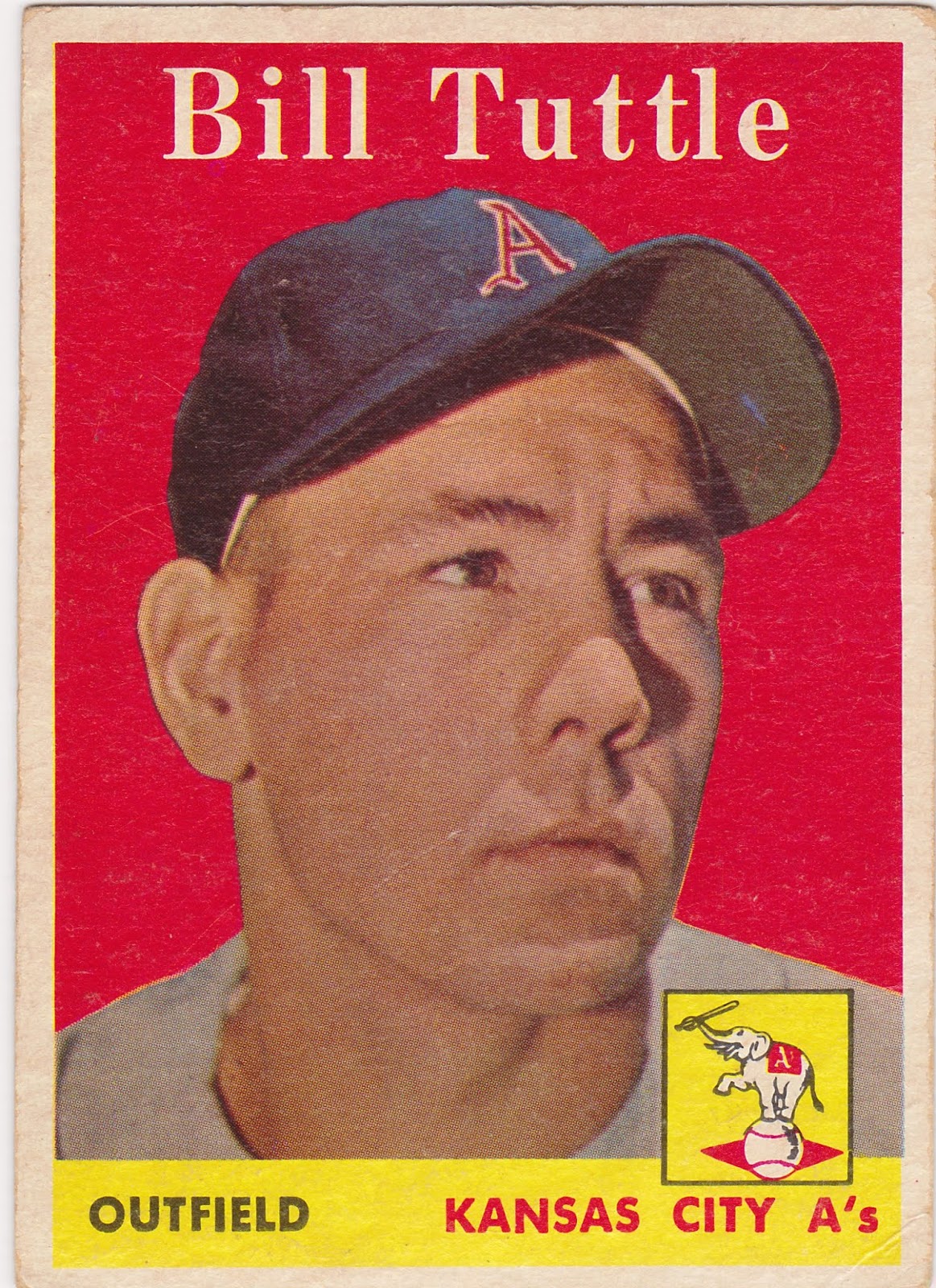
#23 Bill Tuttle


Bill Tuttle played fourteen seasons as a big league centerfielder, primarily with the Tigers and Athletics. His hitting was run-of-the-mill but his speed, glovework and throwing arm stood out and kept him in the lineup even in an age of big sluggers.

Two things I always think of when I hear his name...the fact that he never seemed to smile on any of his cards and that he always had that big chaw of tobacco in his cheek.  That chewing habit ended up killing him through mouth and throat cancer. But in his later life, he used his own medical issues to help stem the use of the products that eventually ended his life. This page tells his story and a few others.

I always like card backs with cartoons showing players engaged in other sports. Tuttle's card references his days as a college hoops star at Bradley.

Saturday, August 11, 2018

#3 Alex Kellner


Alex Kellner made a splash in his rookie season of  1949 as a 20 game winner for a Philadelphia Athletics club that won 81 games finishing fifth in the AL. He was voted second in the ROY balloting behind Roy Sievers.

Kellner never could replicate that '49 and actually lost 20 games the next year as the A's crashed to a 52-102 mark the was the end of Connie Mack's long managing tenure. But Kellner persevered for nine seasons in the A's rotation before being waived and then claimed by the Reds in 1958.

He finished up his career in St. Louis in 1959 and won his 100th game there that year. He led the AL in fielding percentage twice and in 1953 had the top mark in Fielding Independent Pitching (whatever the hell that is).

He comes from a baseball family. According to Baseball Reference his younger brother, Walt, was a teammate with the Athletics in 1952 and 1953. His nephew Frank Kellner and father Pop Kellner both played professionally.

This card lacks gloss but has pretty nice corners. The back suffers from the gum/glue stains I see a lot in this set. Back when I first started blogging the '58 set I noted that the player names on the reverse have variations. Some have the first letter in both first and last names in a cartoonish thick red font. Some, like Kellner's, are black. There doesn't appear to be any pattern to this although a quick flip through my binder seems to show that the plainer, black font letters are more prevalent in the first few series. 

Compare Kellner's name on the card above to the name on Ted Williams' card:


Friday, May 19, 2017

#139 George Brunet


This is George Brunet's rookie card. He had debuted with the A's in 1956 and spent several years bouncing between the minors and majors before establishing himself with the 1965 LA Angels.

He spent the 1958 season in the minors and rehabbing from the effects of a blood clot in his arm. His story..spending time with nine major league teams, becoming a Hall of Famer in the Mexican League where he pitched into his 50s, his crazy off-the-field life...all of it is included in this article on the Hardball Times site. Rather than recount it here I urge you to click thru the link and read the story. I remember Brunet as a character the Jim Bouton immortalized in Ball Four.

One note that jumped out at me when looking at his Baseball Reference page...in 1968 with the Angels he led the league in losses for the second consecutive year but had an ERA of  2.86 and a WHIP of 1.05.

Including his years in the Mexican Leagues he pitched 36 years of organized ball. I kid you not.

Saturday, March 4, 2017

#277 Virgil Trucks


Virgil Trucks pitched for five different AL clubs in a career that spanned two wars. After three years honing his craft in the minors Trucks made a quick appearance with the Detroit Tigers in 1941. He established himself with a combined 30 wins over the '42 & '43 seasons. Then he spent two years in the service on active duty in the Pacific with the Navy.

In 1944 and '45 Trucks pitched for Navy baseball teams alongside big league stars including Phil Rizzuto, Johnny Mize, Dom DiMaggio, Pee Wee Reese and Johnny Vander Meer. His career win total of 177 would have likely topped 200 had he pitched those two years in the bigs.

He was injured and discharged from the service in the summer of '45 and rejoined the Tigers just in time to appear in the 1945 World Series. He made two starts against the Cubs and won Game Two.

Twice an All Star Trucks, in 1952, became the third pitcher to throw two no-hitters in a season. He won 20 games in 1953 with the Browns and White Sox and 19 the following season in Chicago. 1958 was his last big league season and he was clearly hanging on to the game he enjoyed.

The Yankees traded for him that year in a June deal with the Athletics. After an up and down second half of the season he was left off the World Series roster and reduced to a role as batting practice pitcher. In 1959 he was released during Spring Training by the Yanks, pitched some for the Orioles farm club in Miami and then retired. His final card is in the 1959 set.

Trucks died at the age of 95 in 2013 and was known as a good TTM signer.

Saturday, February 25, 2017

#406 Vic Power


Vic Power was born in Puerto Rico as Victor Felipe Pellot. He won seven Gold Gloves, had four AL All Star appearances and eventually sported one of the best baseball names ever. He came up with the Philadelphia A's in 1954 but he had begun his pro career with in Canada's Provincial League in 1949. He was scouted and signed by the Yankees who dealt him to the A's after a couple of strong seasons in their chain. The reason the Yanks got rid of Power isn't certain but his Wikipedia page states this:
[In 1953] Power led the league with a .349 batting average. However, despite his skills he was not invited to spring training in [1952 or 1953].The Yankees' owners at the time, Del Webb and Dan Topping, felt that Power's playing style and personality wasn't suited for the conservative style that they wanted a "black" player to represent as a member of the club. Power dated light-skinned women, leading George Weiss, the general manager of the Yankees, to say that Power was "not the Yankee type".
Take that for what it's worth. Elston Howard eventually broke the color barrier for the Yankees in 1955. This and much of Power's colorful career is discussed in detail on his SABR bio.

Power played 12 years in the majors, nearly all of that time was in the American League with the Indians, Twins and Angels following his time with the A's. He played very briefly back in Philadelphia in 1964 but that was with the Phils. He retired with a .284 average to go along with 126 homers.

He began the 1958 season with the A's but in mid-June was traded along with Woodie Held to the Indians for Roger Maris, Dick Tomanek and Preston Ward. Hitting .302 and riding a 22 game hitting streak at the time of the trade Power raised his average to .312 by season's end. In checking his game logs on Baseball Reference I noticed that Power and the A's played six doubleheaders in just the first half of June that season. They played on on May 30th as well. That's seven 'twin bills' in a little over two weeks. Power played every inning of all of them. He led the league with 10 triples that season as well.

My lasting memory of Vic Power comes from the early 60s. He was playing first base for the Twins or Angels and the Yankees were hitting in the bottom of the ninth. Mickey Mantle grounded out to end the game but as you watched the screen you expected to see Mantle crossing 1st base. But all you saw was Power making the put out and then looking toward home plate. The Mick had pulled a hamstring or a calf muscle and was in a heap halfway to first. Weird the things you recall from your youth. I have no idea why I know it was Vic Power at first after all these years but I'm dead sure of it.

I really like this card, partially for the all-too-rare light blue color but also because Power was such a fun player to watch in my early years as a fan. It's a bit the worse for wear but not so bad that I feel the need to upgrade it.

Sunday, February 19, 2017

#329 Bob Cerv


Bob Cerv made three tours of the majors with the Yankees during his 12 year career but his best season (by far) came with the Athletics in the year this card was issued, 1958. Cerv had come up with the Yankees in 1951 after signing out of the University of Nebraska and a brief minor league tuneup. For six seasons he played in a reserve/pinch hitting role and returned to the minors a time or two.

He was traded to KC for the '57 season and got his first shot as a starter. He had a decent season but there was nothing to indicate what was in store for Cerv in 1958. That season, despite playing for months with a jaw wired shut as the result of a home plate collision, Cerv hit 38 homes, drove in 104 runs while hitting .305 with a .592 SLG. He made his only All Star squad that year and batted cleanup for the AL.

He fell off as quickly as he rose and after the '59 season he bounced back to the Yankees and then was drafted by the Angels in the expansion draft of 1961. The Angels traded him back to the Yanks and in 1962 he was sold to the Houston Colt.45s where he played about a month before being released. That was the end of his playing career.

Cerv played in three World Series with the Yanks and won a ring in 1956. There is a funny story concerning Cerv and Casey Stengel that gets retold a lot. It goes like this:
According to sportswriter Robert Creamer, interviewed for the Ken Burns film Baseball, one afternoon, Yankees manager Casey Stengel approached Cerv in the Yankees' dugout, sat down nearby, and commented "There's not many people that know this, but one of us has been traded to Kansas City."
Problem is that Cerv was sold to Kansas City, not traded. And the deal was done a week or so after the 1956 World Series was over. It's pretty unlikely that Cerv and Stengel were on a bench anyplace at that point. But the story does sound like Casey!

Cerv is 91 now and living in Nebraska. There is a nice article about him in an online Saturday Evening Post from 2010. Well worth the read. And the picture of the fateful home plate collision with Tiger catcher Red Wilson is there.

Not many of the light green backgrounds show up in the '58 set. I'm not crazy about them but they are sort of a welcome break from all the yellow ones. Topps used the same color in 1959 and it works better in that set IMHO.

Monday, January 2, 2017

#69 Wally Burnette


Knuckleballer Wally Burnette pitched in 68 games for the Athletics over three seasons, 1956 thru 1958. He had been in the Yankees' minor league system (and had some outstanding seasons there) before being dealt to the A's for Tommy Lasorda. He shut out the Washington Senators, 8-0, at Griffith Stadium in his big league debut.

In late June of 1958 he was sent to the minors after a rough month on the mound and he never returned to the majors. His career stats show a 14-21 record with a respectable ERA of 3.56 and a 1.35 WHIP. He owned and operated a grocery in his hometown in Virginia after he retired.

Very typical 1958 Topps card. Head shot with what appears to be an airbrushed logo on the cap. Not in the best shape (I have a bunch with that same corner crease) but not one I'll be interested in upgrading.